• Skip to primary navigation
  • Skip to main content
  • Skip to footer
Chordata Capital

Chordata Capital

Investment with a Backbone

  • About Us
    • Backbone
    • Ecosystem
    • Our Team
  • Investment Advising
    • Our Approach to Investing
  • Impact
    • Our Investments
    • Chordata Cohort
  • Resources
    • Blog
    • Zine
    • Press
  • Contact Us

Kate Poole

Investing in the Movement for Tenant Power and Community Controlled Real Estate

March 28, 2024

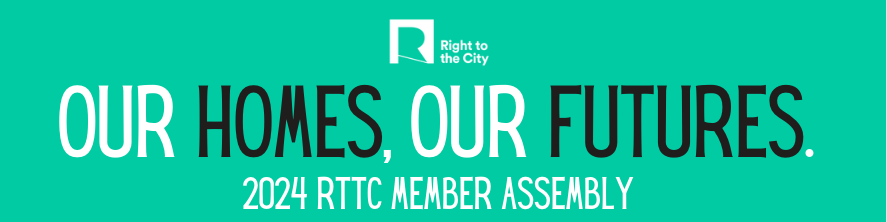
We recently returned from Right to the City Alliance (RTTC)’s member assembly in New Orleans. We were incredibly grateful to be invited into this space and for the chance to learn directly from organizers building the solidarity economy!!! RTTC is a national alliance of more than 90 community-based organizations growing grassroots power to halt gentrification and displacement, and build democratic, just, and sustainable communities.

We’ve had a yearning since we first started with Chordata to get clear about what social movement investing looks like in our work. RTTC is developing an analysis and roadmap for coordinated national work for housing justice, including a clear analysis that Wall Street is not our friend. We loved chanting “Down, down with Corporations! Up, up with Liberation!” And are lit up to be in relationship with RTTC and mobilizing investments in line with this beautiful roadmap of what it takes to win!

We participated with groups across the country in building a shared analysis about what we’re up against. In a brilliant “State of the Movement” plenary, RTTC’s organizers described how the far right neo-fascist agenda is being developed and implemented in the US South, and how these strategies are coming for the rest of the country. They described how the rise of the far right is directly linked to the failure and devastating impacts of neoliberalism in this country. As neoliberalism stopped working for white working class people, the solution that’s been offered is neo-fascism, often couched in progressive terminology like “the elites don’t want you to have money or power”. The rallying cry at the assembly was that in order to defeat neoliberalism we have to beat back the far right, we need to focus our efforts in the South, and we need to block false solutions and build real alternatives.Towards these ends, we learned about core interventions like community controlled real estate, corporate targeting, rent strikes and tenant takeovers. One of Chordata’s investing priorities is community controlled real estate, and we felt so much alignment with RTTC’s vision! Some of our current community controlled real estate investments include EBPREC, Local Code Kansas City, Seed Commons, Cooperative Fund of the Northeast, and LEAF. 
Visiting Jane PlaceWhile at the convening we visited an amazing New Orleans-based project called Jane Place. They create permanently affordable housing, advance tenant rights, expand housing security, and uphold equitable housing patterns and land use planning. In 2016, Jane Place opened the first permanently affordable apartment building in New Orleans- the Palmyra Street Apartments- and they are currently working to develop 14 more units of permanently affordable housing.Leaders from Jane Place spoke at the conference, offering framing about the impacts of disaster capitalism on their city, as well as how the work they’re doing to create community controlled housing is tied to climate resiliency. So many houses in New Orleans are being purchased and turned into Airbnbs, leading to displacement of local people. We heard about Jane Place’s incredible organizing work to win new limits aimed at curbing short term rentals in residential neighborhoods- this means there can only be one Airbnb per square block in New Orleans! What’s beautiful about the work of Jane Place is that in the face of displacement and gentrification and super high rents, they’re able to purchase buildings and rent them at really affordable prices to local residents. 
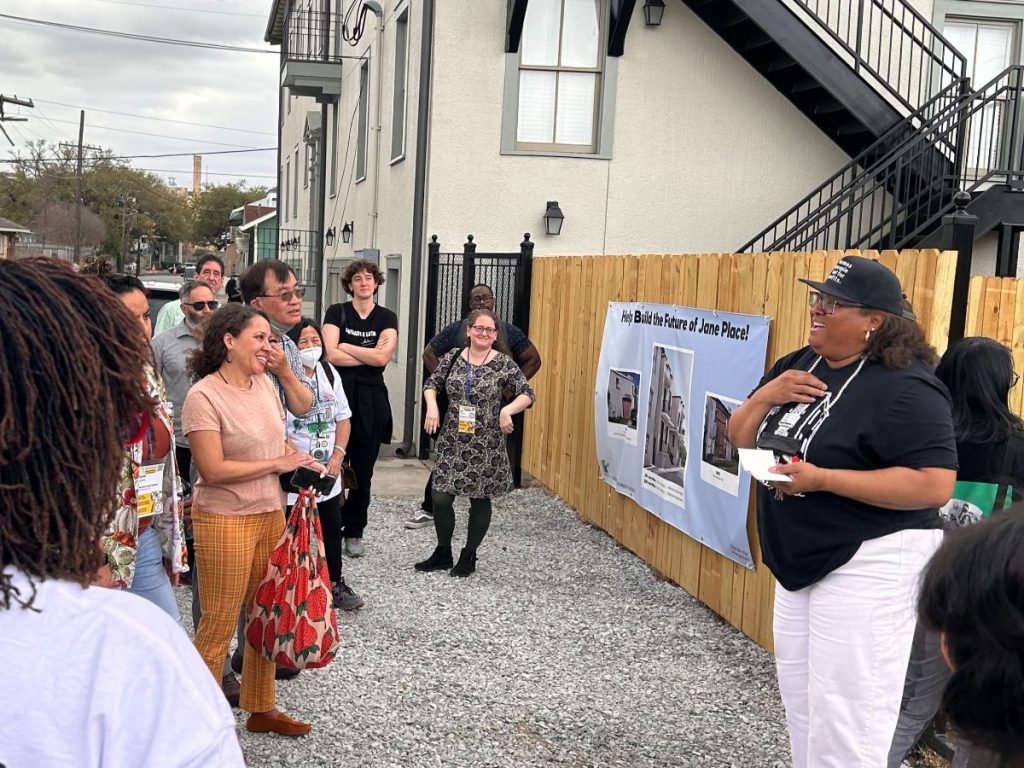
Here we are at Jane Place, hearing from Executive Director Veronica Reed about their work to resist displacement and purchase properties for affordable housing

Looking under the financial hood of tenant takeoversAlso at the convening, we heard from several groups that were able to organize tenants to take over properties!! One project with over 80 families ended up having to take on an around $12 million loan that they are paying around 8% interest on, a super extractive rate of return. That pencils out to around $1M in interest each year, which is an extra $12,500 that each of those families has to pay a year just to cover the interest! This creates a huge burden on tenants who are just trying to live in their homes. Stories go viral about beautiful tenant takeovers, as they should. But if you’re not looking under the hood and seeing what’s happening with the financing, there can still be a lot of extraction happening. We’re really curious to look at where the opportunities are to bring more values aligned, lower interest and no interest capital to tenant takeovers so that people aren’t saddled with so much interest. If we want to see more of these tenant takeovers happening all across the country it’s going to take a lot more capital. One of our major takeaways from the convening is that we need more people on the investment side of things coming in alongside this amazing organizing. We want to see those of us on the investment side of the ecosystem communicating with groups about different kinds of values-aligned capital that’s available, and mobilizing local and national capital to support these incredible projects with more favorable terms.
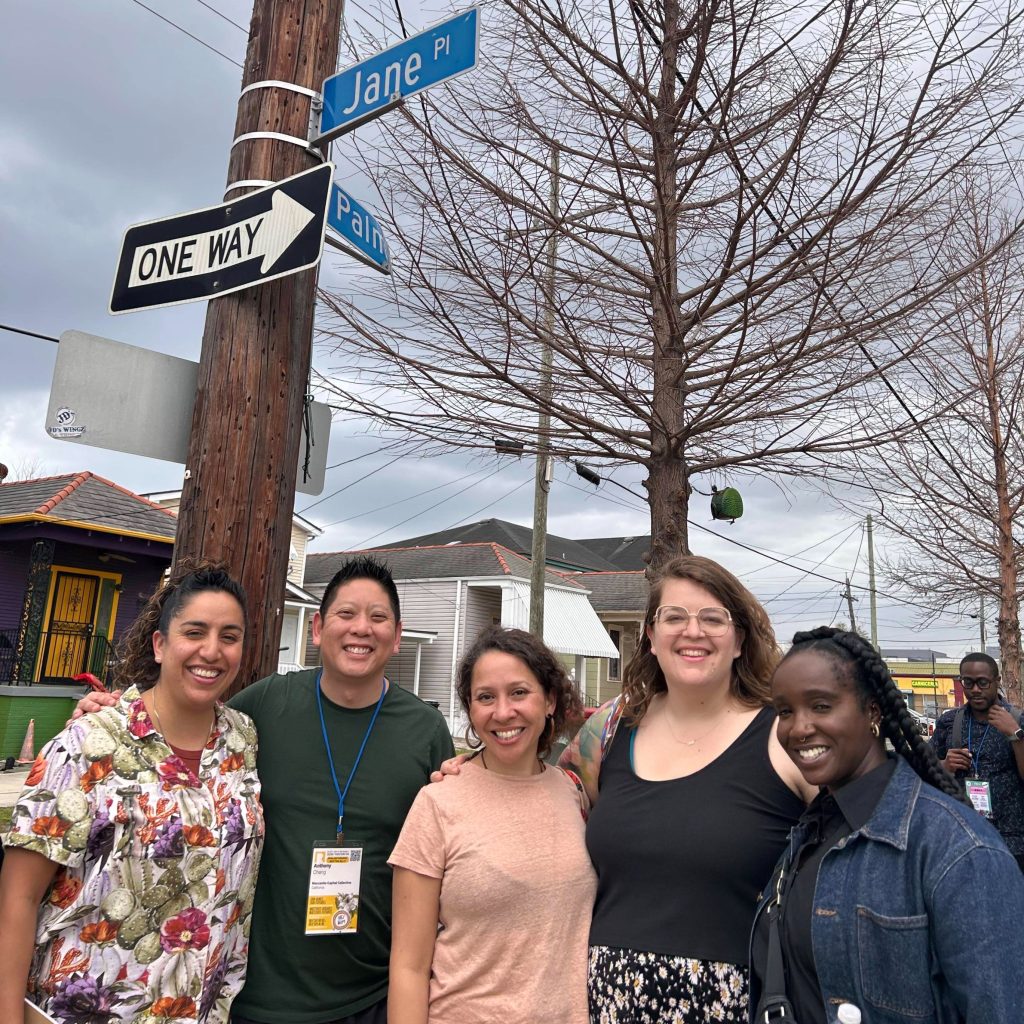
We saw so many beloved colleagues! Here we are hanging out at Jane Place with our dear friends Mariela Cedeño and Anthony Chang of Manzanita Capital Collective, and Nwamaka Agbo of Kataly Foundation.

For those of you wondering how you can connect more to this work, here are a few places to start:Find Right to the City affiliates or other housing justice organizers in your community and figure out how to uplift that work and support renters in your region Look into your investments to see if you hold real estate investment trusts (REITs), or shares in corporations or private equity companies that are buying up apartments and houses and extracting wealth from tenants. If you’re a Chordata Client, we’re already working with you to divest from Wall Street! If you manage your own investments, consider divesting and shifting that capital into community-controlled real estate instead!

 If you’re a member of Resource Generation, get plugged in to their new national campaign on housing, in partnership with Center for Popular Democracy’s House Everyone Campaign!
 Reach out to Fernando Abarca at Right to the City to learn how to invest in their fund and move capital to support their work!
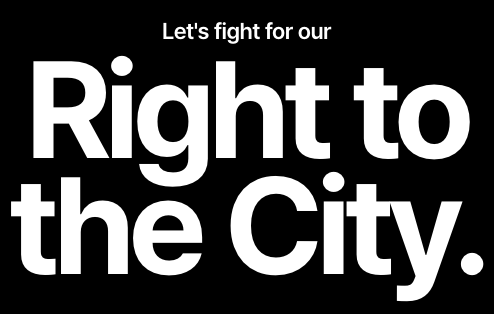
a call to action from Right to the City Alliance! 

Our Trip to the South with RUNWAY: Building Infrastructure in Support of Black Economic Power

July 25, 2023

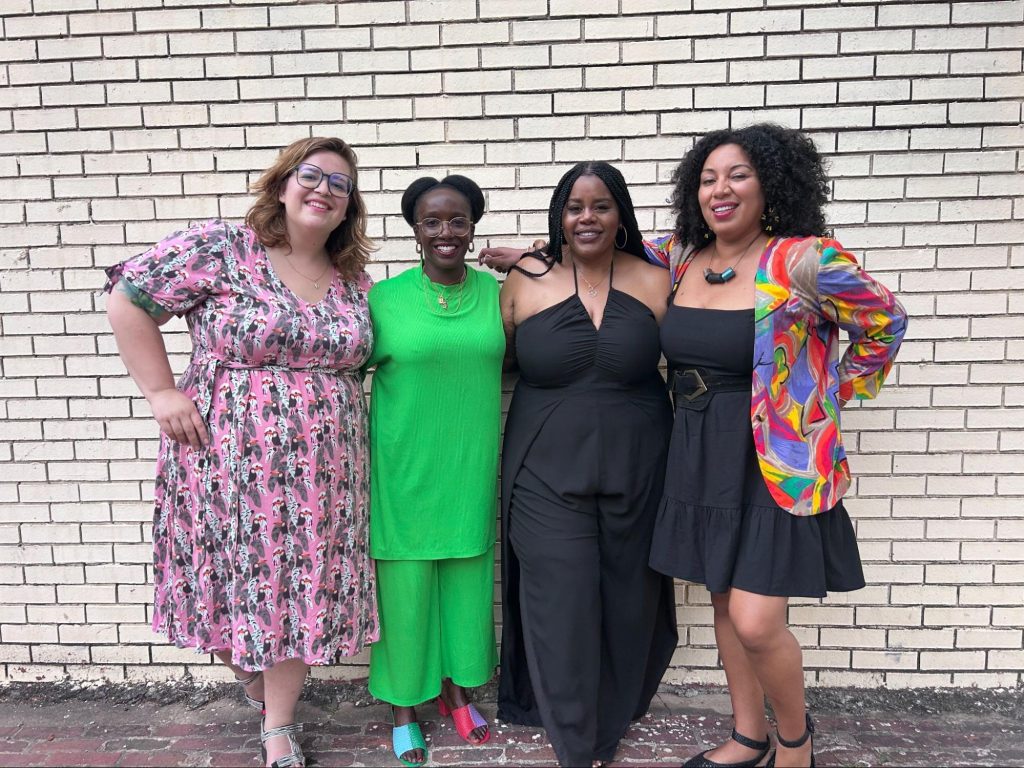
RUNWAY is one of Chordata’s core partners in the work of repair. Led by an incredible leaderfull team of creative Black women, RUNWAY is a financial innovation firm working nationally to support Black economic power building. Chordata is invested in their work in a variety of ways: In their CD program in partnership with Berkshire Bank, in Something Better Foods, a company run by RUNWAY entrepreneur Chef GW Chew, and we are in the process of investing in REAL People’s Fund, a community-governed fund in the Bay Area that RUNWAY leads.

Excitingly for all of us, RUNWAY just launched ROOTED, a 10-year commitment to investing in the South, which will include a national fund that can support Black creatives and entrepreneurs across the country. The project is led by our friend and colleague, Jessica Norwood, the Founder and CEO of RUNWAY and a frequent guest in our cohort programs, sharing stories and examples of repair.

In May of 2023, RUNWAY hosted a delegation to visit Alabama! It was a learning trip with the full RUNWAY team and their allied funders, to visit with several Black communities in Alabama to explore what it would be like to build an economy in Alabama that loves Black people.

I felt so lucky to be invited and to attend! I felt really lit up by this trip. It was really special for me as a white, wealthy inheritor to be welcomed into Black-led work and Black-owned spaces in the South. I felt deeply moved when trusted colleagues would name me and name the importance of Chordata’s work in their presentations to these communities. 

We started in Mobile, where Jessica grew up. Her father was the mayor of Pritchard, a Black town right outside of Mobile. It was so powerful to hear Jessica in conversation with her father about what it takes to build and sustain Black political and economic power. We traveled to neighboring Africatown, and visited the graves of survivors of the Clotilda, the last known slave ship that landed in the Mobile delta in 1860. There’s an incredible film, Descendant, that documents the story and includes film footage of Cudjoe Lewis, one of the oldest survivors, taken by Zora Neale Hurston in 1927 (she tells his story in his own dialect in Baracoon). 

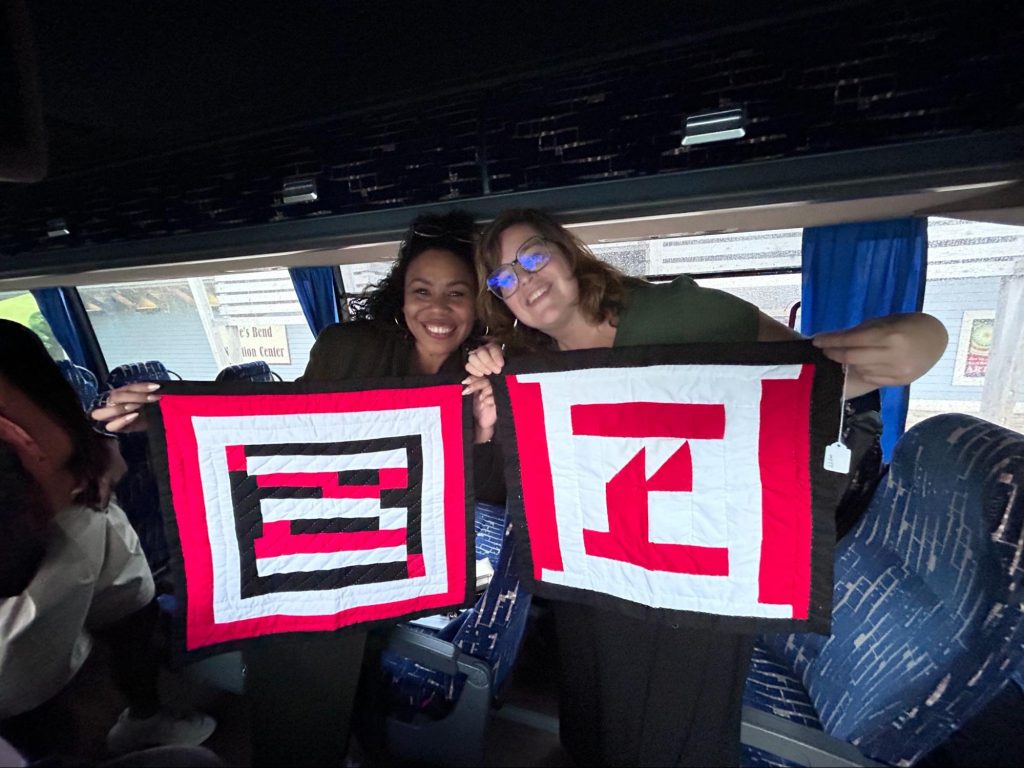
Next we traveled to Gee’s Bend. My mom was obsessed with these gorgeous quilts when I was growing up, so the art was familiar to me. There’s been so much work done to lift up these artists and their art, and interrupt legacies of Black artists’ work being stolen, and some quilters have built some wealth. But it’s wild to see how this success has not translated into community wealth or infrastructure–there’s no sanitation system, no gas station, no grocery store, no cell service, no internet, no place to stay, in Boykin, Alabama. There’s a ferry across the river, or a 45 minute drive to the nearest town. They are building a beautiful visitor center, hosting an annual “Airing of the Quilts” festival and reviving the Freedom Quilting Bee, a Black women’s cooperative founded in 1966. But there’s still so much need for investment.

Kate with Dr. Janelle Williams of the Atlanta Wealth Building Initiative

Our journey had so many special moments including a mardi gras band and farm-to-table dinner at the historic Black-owned Jenkins Farm, and a visit to Michelle Browder’s visionary project Mothers of Gynecology. And we ended in Montgomery, Alabama, where we heard from Black artists and creatives at a hip Black-owned gallery and event space. Throughout the trip, the RUNWAY team centered Black artists and Black art. During a panel Nina moderated with Black artists in Pritchard, she proclaimed: “Art and creativity is what makes life worth living.” Even in our side conversations, we found ourselves talking about the art we make, the art we dream of making, and how much creativity is required to be in this work of reimagining the economy. How finance itself is an art, and not a science. In Montgomery, I remember Jessica saying “What does it mean to be a creative entrepreneur? All Black Entrepreneurs have to be creative to survive and thrive.” 

Kate with Nwamaka Agbo, Jessica Norwood and Nina Robinson

And on our last day we visited Erica Washington at Clarke Street Fund. She sat us all down under a huge tree, and as I was enjoying the shade and wondering if it was a walnut, she shared that we were on the land of her Great-Grandfather and gathered under a more than 100 year old pecan tree, that still offered a bumper crop every other year. We were able to help weed some garden beds, and get our hands in the soil, and they offered us gorgeous refreshing watermelon juice. Across the street is an empty lot that used to house a grocery store run by her family. Now Erica and her sister are continuing that legacy and working to feed the community. 

On our first night in Mobile, Nwamaka Agbo shared: “We have to be clear that we too are trying to be transformed in doing this work.” It was not that we were trying to bring our ideas or strategies and impose them on these communities, where there is such a history of trust being broken and outsiders coming in to try to “fix” and ultimately abandon them. The trip was intended to change us, to reshape how we as investors were imagining returning resources to the South. I’m excited to return to Alabama as RUNWAY builds out more infrastructure to support Black creatives and entrepreneurs in the South, and I hope members of the Chordata community will come with me!

Sermon from Beth Am’s Juneteenth Shabbat

June 21, 2021

by Kate Poole

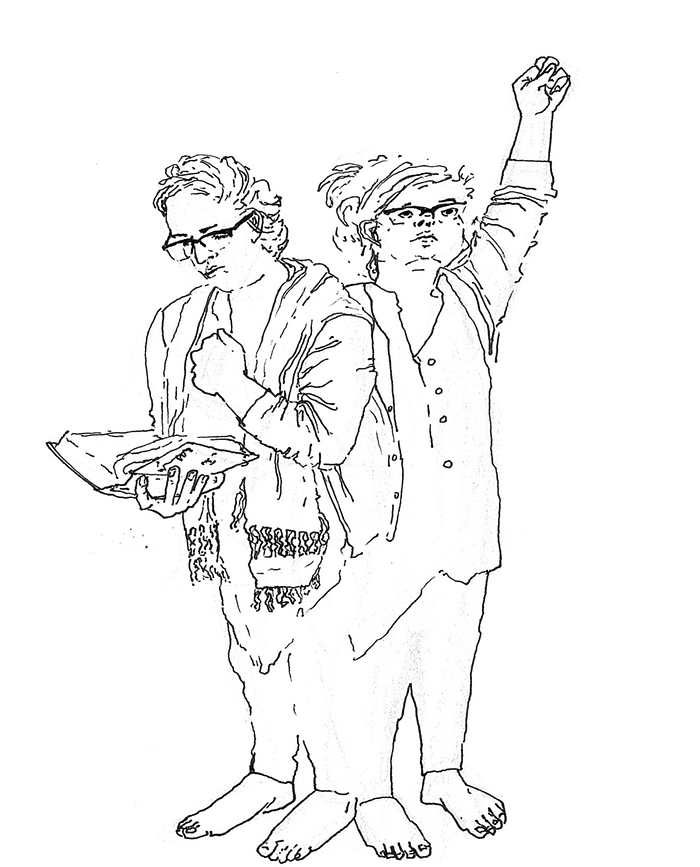
A drawing from my comic Repentance and Reparations

I am really grateful and honored to be here. I was invited to share about the work that I’ve done in my life around racial justice, reparations, and supporting black sovereignty. My family has been a part of this congregation for generations for 6 generations. My great-great-great-great grandfather Michael Simon Levy was a founder, so it’s a powerful and vulnerable moment for me to be sharing my life’s work with you today.

When the Rabbi invited me to speak on Black Sovereignty I was moved, because I think that is such a powerful framework to bring to discussions of racial justice. It also might be a phrase that’s unfamiliar to some of you. You might be wondering, how can we support black sovereignty? Is there a difference between doing work that benefits local black community members (say tutoring or street clean-ups) and supporting black sovereignty?

Yes. Sovereignty is about who decides what’s needed and how resources are allocated. Supporting black sovereignty is about giving both resources (money, time, expertise) and power (the decision-making power over how those resources are spent).

As an example, even though our congregation is full of brilliant minds, no one knows what is best for someone else. We can’t decide what another community needs.

Women are the real experts on women’s rights, black activists are experts on anti-black racism, and any attempt to solve a social problem must be shaped and led by those affected.

I often draw on the Jewish framework of Teshuvah to anchor my work supporting Black Sovereignty. I find Jewish support for reparations in Teshuvah.

You’re probably most familiar with Teshuvah in the context of Yom Kippur. Literally meaning to turn or return, Teshuvah is a process of self-examination, asking forgiveness, and making things right by repairing the damage. The responsibility to make Teshuvah is both individual and collective — which is one reason why much of the liturgy of Yom Kippur asks forgiveness for the sins that we have committed. There is a balancing of specific ways you haven’t measured up, and there is an acknowledgement of collective and systemic harm we’re working towards transforming. There is a balance of looking at our personal shortcomings, and there is an acknowledgement of the need to think, talk and act collectively towards addressing systemic harm.

Massive harm created the current disparities in our economy. Racism and white supremacy have shaped who has access to wealth. The practice of Teshuvah offers us clues and a framework for what it looks like to work towards repair and return.

This has been a long learning journey for me. When I was growing up, when we would drive from Pikesville to Shul, I didn’t have a strong historical sense of why we were traveling from a Jewish neighborhood to a Black Neighborhood to go to synagogue. I knew that when we parked on Linden Ave and walked over, I felt out of place, but I also knew that my great-great-grandmother had an apartment at Eutaw Place a stone’s throw from here.

I was raised to be generous, to seek justice, to be kind. But in doing that I looked outside of myself — tutoring young black students in city schools, interning at a domestic violence legal aid program, building a school in Costa Rica — seeing poverty and racism out there, and wanting deeply to help. I didn’t learn to ask how am I implicated.

I didn’t understand how my privilege and opportunities were connected to the poverty and violence I saw locally and globally.

I didn’t see how the lack of resources in city schools and court systems were connected to bigger patterns of white flight and redlining. I didn’t see how racism was connected to who has access to wealth and whose wealth is stolen.

My politics shifted in college, and again in showing up for Occupy Wall Street and the Black Lives Matter movement. During Occupy Wall Street I learned about how the 1% owns over half of global wealth. I learned how the accumulation of wealth has always been connected to racial discrimination.

The accumulation of wealth in this country is based on the theft of land from native peoples, the kidnapping and enslavement of Africans, and policies and practices created by governments and financial institutions — like the Homestead Acts, the GI Bill, redlining, racist deed covenants, discriminatory lending practices — that built wealth for some at the expense of others.*

If we look at all of this harm, and look at the racial wealth divide in our country, we can see a deep wound that needs healing. Apply the concept of Teshuvah to contemporary economic and racial injustice, and we can make the case for reparations. This includes pushing our country and local governments to pay reparations to historically oppressed and economically exploited communities, by supporting legislation like HR 40 and S. 1083. In my own work, I focus on supporting individual and institutional inheritors in bringing a reparations lens to their giving and investing.

Some white Jewish Americans have a complicated relationship to their whiteness and the history of whiteness in this country. This country has discriminated against Jews historically, and there’s a real threat of violence today from anti-semitic white nationalists. And also, many white Jewish Americans have been able to accumulate wealth, and accumulating wealth in this country means benefitting from racist systems.

In my own journey of reparations, I’ve looked to move the money I’ve inherited to organizations and businesses that are building economic self-determination for Black communities.

Around this time last year, a colleague introduced me to Cole and Aisha Pew of Dovecote Cafe. I had been giving to Black-led organizing and activism in Baltimore, and investing in local community finance institutions, but I was looking to invest in work that was explicitly building Black Sovereignty. Cole and Aisha are building Black Economic Power — and when we pulled up to their joyful, gorgeous cafe, I was surprised to find they are doing that work in the footprint of the neighborhood where my family first starting accumulating wealth before moving to the county. I was shocked and delighted that the hub of their work is just one block from Beth Am, where I was batmitzvah-ed! I was moved by their model, and made the largest financial commitment of my life, with the wire going through last year on Juneteenth. I felt deeply grounded in the healing work of investing in Black Sovereignty, and in building Black-Jewish solidarity.

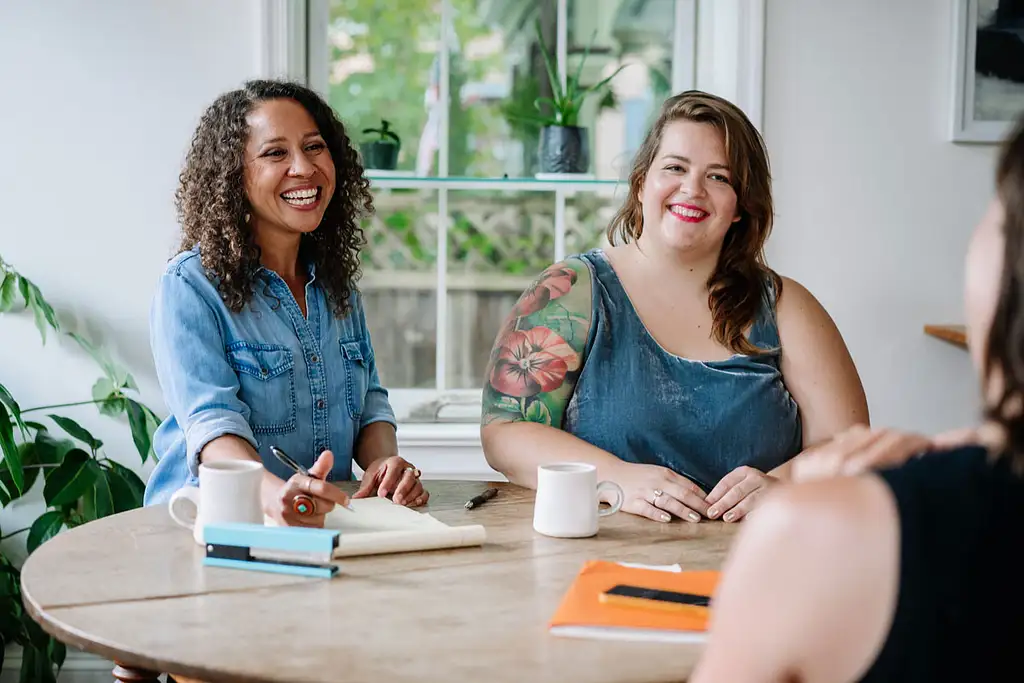
In addition to investing in businesses that are closing the racial wealth divide by building black economic power, I also support wealthy white investors in redistributing their wealth and integrating their giving and investing practices. I help inheritors trace the history of wealth accumulation in their families and look for opportunities for repair. I do this work through Chordata Capital, an investment advisory firm I co-founded with Tiffany Brown. Together work as investment advisors with investors who are committed to racial justice, wealth redistribution and reparations. Part of my accountability practice as a wealthy white woman is being in partnership with Tiffany, a Black mixed-race working class woman. I was moved to hear that Beth Am has developed a similar model of accountability in their work with the community, to have the board of In For Of to be half Jews from the shul and half Black community members.

When I started my work with Tiffany, we realized that in order for us to step into an equitable partnership, we needed to share resources. I had enough money to put my full time and attention into our business, and if I didn’t financially support Tiffany to put her full time into our work, there would be a warped power dynamic from the start. We saw that our work of racial and economic justice had to start at home, and a foundation where we were equitably sharing resources would set the tone for the integrity we would bring to our work with partners and clients. Supporting Black Sovereignty includes financially supporting Black leadership.

As the racial wealth divide grows (with the average Black family’s median net wealth set to hit zero by 2053**), we need to take greater risks to bring justice, connection and financial resources to support the self-determination of Black Communities.

I’m grateful that Judaism has a solid framework for repentance. Teshuvah, Tfillah, Tzedakah: to repair, to pray, to share resources.

We need each other. Beth Am is lucky to be working in relationship with local Black leaders in the community. Our work is more powerful and grounded when it is anchored in loving, accountable relationships. As we continue to grow by being in relationship, I hope we can also grow in the way we share resources. I’d love to continue to be a part of that work with you all. Shabbat Shalom.

*****************
Kate delivered this sermon and participated in a Q&A with Rabbi Daniel Cotzin Burg at Beth Am’s Juneteenth Shabbat on June 15th, 2019. She also compiled a learning document for the congregation on these themes, 
that’s available here. To learn more about investing with a reparations lens, you can sign up for Chordata Capital’s Newsletter or attend our webinar on July 2nd.

*United for a Fair Economy: Government Boosts and Blocks of Building Wealth http://www.faireconomy.org/boostsandblocks

**Institute for Policy Studies report The Road to Zero Wealth: How the Racial Wealth Divide is Hollowing out the Middle Class

Footer

Receive updates, articles and comics from Chordata Capital.

* indicates required
I...
/* real people should not fill this in and expect good things - do not remove this or risk form bot signups */

Intuit Mailchimp

  • About Us
    • Backbone
    • Ecosystem
    • Our Team
  • Investment Advising
    • Our Approach to Investing
  • Impact
    • Our Investments
    • Chordata Cohort
  • Resources
    • Blog
    • Zine
    • Press
  • Contact Us

Tiffany Brown and Kate Poole are Investment Advisory Representatives of Natural Investments PBLLC. Natural Investments is an independent Registered Investment Advisor firm. Chordata Capital is not a registered entity and is not an affiliate or subsidiary of Natural Investments PBLLC . See our Disclosures and Disclaimers and read our Form CRS.

Copyright © 2025 Chordata Capital · Site Credits

Receive updates, articles and comics from Chordata Capital.

* indicates required
 
 
/* real people should not fill this in and expect good things – do not remove this or risk form bot
signups */